

Most online stores in Australia bleed marketing budget on ads while organic revenue sits untapped. Partnering with the right ecommerce SEO agency changes that equation permanently. This guide exposes what genuinely works, what agencies get wrong, and exactly what your store should demand before signing any contract.
Why Most Ecommerce SEO Agencies Miss the Revenue Mark
Choosing an ecommerce SEO agency is one of the most consequential decisions an Australian online retailer makes. Yet most businesses report the same frustration – traffic climbs, but revenue does not follow. That disconnect reveals a fundamental problem with how many agencies approach ecommerce SEO.
Generic SEO firms apply blog-and-backlink strategies designed for service businesses. Meanwhile, ecommerce stores operate in a completely different search landscape. Product pages, category hierarchies, faceted navigation, inventory fluctuations, duplicate content from manufacturer descriptions, and thin-page penalties all require a specialist approach. Without that depth, agencies produce rankings that look good in reports but deliver little at the checkout.
VERIFIED FACT
According to Google Search Central, structured data including product schema markup is one of the most impactful enhancements for ecommerce visibility in Search. Rich results displaying price, availability, and review ratings consistently outperform standard blue-link listings in click-through rate.Source: Google Search Central – Structured Data Documentation (developers.google.com/search/docs)
Furthermore, Australian ecommerce is highly competitive. According to the Wikipedia overview of ecommerce, Australia ranks among the top-ten global ecommerce markets by consumer adoption. That means search competition for product keywords is intense and growing. A generic SEO approach simply cannot compete in that environment.
Consequently, revenue-focused ecommerce SEO demands a completely different methodology. It starts with architecture, moves through technical health, builds authority through content and links, and always measures back to organic revenue rather than vanity metrics.
Moreover, the agencies that genuinely deliver measurable growth share specific habits. They conduct deep ecommerce SEO audits before touching rankings. They map keyword intent against purchase funnel stages. They prioritise crawlability and indexation before content. These are not optional extras – they are the foundation.
At Million Hits, our ecommerce SEO methodology is built entirely around organic revenue outcomes. We do not measure success in keyword count alone – we measure it in sessions, conversion rates, and dollars earned from the organic channel.
Shopify and WooCommerce SEO – Platform Realities in 2026
Platform choice shapes SEO strategy fundamentally. Both Shopify and WooCommerce power the majority of Australian ecommerce stores, and both come with platform-specific SEO challenges that need expert navigation.
Shopify SEO Limitations Australian Stores Must Understand
Shopify is excellent for rapid store deployment. However, it introduces several structural SEO challenges that frustrate even experienced marketers. First, Shopify forces a fixed URL structure for products, collections, and blog posts. This means product pages always carry the /products/ prefix and collection pages sit under /collections/, regardless of your preferred hierarchy.
Additionally, Shopify generates duplicate URLs when products appear in multiple collections. A product accessible through both /collections/shoes/products/sneakers and /products/sneakers creates a canonical challenge that Google handles inconsistently without deliberate intervention. Furthermore, Shopify restricts direct robots.txt editing, limiting crawl budget control on large stores.
| Duplicate URL Structure Products in multiple collections generate duplicate URLs. Canonical tags must be audited and corrected manually for each affected product. | Restricted robots.txt Shopify does not allow full robots.txt customisation. Crawl budget management for large stores requires alternate technical approaches. | Collection Page Limits Shopify collection pages offer limited on-page content areas. SEO-rich category descriptions require creative template workarounds. | App-Heavy Slowdown Third-party apps frequently degrade Core Web Vitals scores. Page speed optimisation requires app auditing on every Shopify store. |
Despite these limitations, Shopify SEO in Australia remains highly viable when managed by specialists. The platform offers native sitemap generation, clean HTML output, and broad app ecosystem support for schema and structured data. A skilled technical SEO team works around the restrictions rather than being limited by them.
WooCommerce SEO Strategy – Greater Flexibility, Greater Responsibility
WooCommerce, built on WordPress, offers substantially more SEO flexibility than Shopify. Custom URL structures, full robots.txt control, unrestricted canonical tag management, and deep plugin integration make WooCommerce the preferred platform for complex SEO strategies. However, that flexibility introduces its own set of challenges.
WooCommerce stores frequently suffer from bloated plugin installations that degrade page speed. Moreover, default WooCommerce configurations generate excessive tag and attribute archive pages, which thin out the crawl budget and create low-quality indexed pages at scale. Without deliberate WooCommerce SEO strategy, these issues compound rapidly as the product catalogue grows.
Effective WooCommerce SEO optimisation therefore begins with a structured audit. That audit maps every page type, evaluates index health, identifies orphaned pages, and prioritises the technical tasks that deliver the fastest ranking improvements. Our SEO audit service covers exactly this process for WooCommerce stores across Australia.
Technical SEO for Australian Online Stores
Technical SEO forms the bedrock of every successful ecommerce organic traffic strategy. Without it, even the best content and strongest backlink profile will underperform. Moreover, technical issues are often invisible to store owners, which means they persist for months or years while silently suppressing rankings.
Core Technical Issues That Drain Ecommerce Rankings
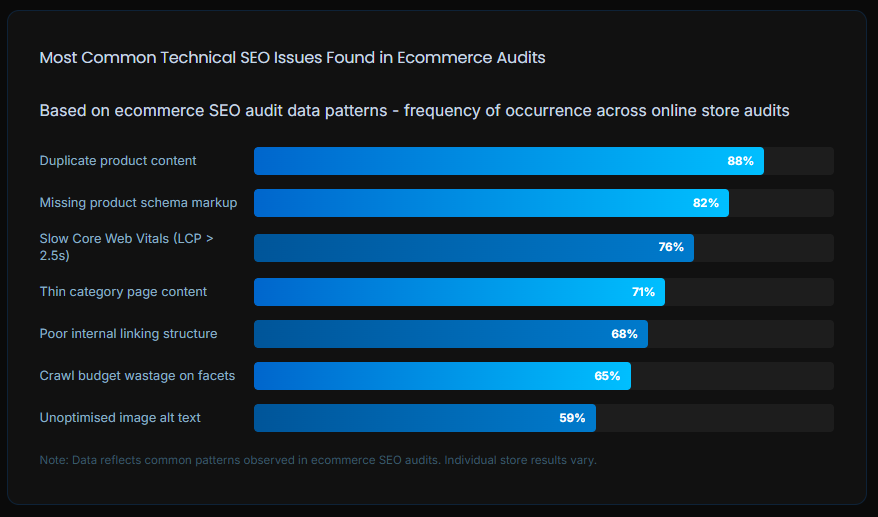
An ecommerce SEO audit almost always surfaces the same cluster of technical problems across Australian online stores. Understanding these issues helps store owners ask the right questions before engaging any agency.
Product Schema Markup – The Missed Revenue Lever
Product schema markup is consistently the most underutilised technical SEO element across Australian ecommerce stores. When implemented correctly, product schema enables rich results in Google Search – displaying star ratings, price ranges, stock availability, and review counts directly in the search results page.
Those rich snippets meaningfully increase click-through rates. Specifically, Google’s own documentation on product structured data confirms that eligible pages may display review snippets, price, and availability status in search results. This visual differentiation is a competitive advantage that most ecommerce stores simply leave on the table.
Our technical SEO team implements Product, BreadcrumbList, and FAQPage schema across ecommerce stores as standard practice. The impact on click-through rate typically becomes measurable within 4 to 8 weeks of implementation.
Site Architecture and Internal Linking at Scale
Large ecommerce catalogues create site architecture problems that compound over time. Without deliberate internal linking strategy, PageRank pools in the homepage while deep product pages remain chronically underpowered. Additionally, category pages compete with product pages for overlapping keyword clusters, creating cannibalisation that suppresses both.
An effective ecommerce SEO approach maps keyword intent against page type, then builds internal linking rules that channel authority deliberately. Category pages target broad head terms. Product pages capture transactional long-tail queries. Supporting blog content addresses informational intent and funnels readers toward category pages via contextual links.
Our SEO copywriting team produces category and product descriptions with this intent architecture built in from the first draft – not added as an afterthought.
Product Pages vs Category Pages – Getting Priority Right for Ecommerce SEO
One of the most common strategic errors in ecommerce SEO is treating product pages and category pages as interchangeable ranking targets. They serve completely different functions in the search funnel, and they require different optimisation approaches.
The core rule: Category pages rank for volume – they capture users browsing with broader intent. Product pages convert – they capture users ready to buy a specific item. A strong ecommerce SEO strategy builds category authority first, then amplifies individual product pages for transactional queries.
Why Category Pages Drive Faster Ecommerce Ranking Wins
Category pages sit higher in the site hierarchy, accumulate more internal links naturally, and target higher-volume keywords with commercial intent. For an Australian outdoor furniture retailer, ranking the Outdoor Chairs category page for “buy outdoor chairs Australia” drives substantially more traffic than ranking an individual product for “Hampton wicker armchair dark grey.”
Nevertheless, most ecommerce stores either publish category pages with zero written content or fill them with thin, generic descriptions. Both approaches waste significant ranking potential. A well-optimised category page includes a keyword-rich introduction, subcategory navigation, buyer guidance content, and FAQs that address real pre-purchase questions.
| Element | Category Page Priority | Product Page Priority |
|---|---|---|
| Keyword intent | Informational + Commercial | Transactional |
| Search volume | High (head terms) | Lower (long-tail) |
| Conversion rate | Moderate | High |
| Internal links received | High (menu + breadcrumbs) | Moderate |
| Schema type | ItemList, BreadcrumbList | Product, Review, Offer |
| Content length | 400-800 words recommended | 300-600 words recommended |
| Duplicate risk | Low | High – requires canonical strategy |
| Ranking timeline | 3-5 months typically | 4-8 months typically |
Product Page Optimisation That Actually Converts
Product page SEO optimisation must serve two masters simultaneously: Google’s crawlers and human buyers. These goals align more than most store owners realise, because Google increasingly rewards content that satisfies user intent deeply. Therefore, optimised product pages are also better sales pages.
Specifically, effective product page optimisation includes unique product descriptions that avoid manufacturer copy, keyword-integrated page titles, schema markup for price and availability, optimised image alt text, structured feature lists, user-generated reviews for E-E-A-T signals, and clear CTAs above the fold. Our SEO copywriting service covers all of these elements as standard deliverables.
Content Strategy That Drives Ecommerce Organic Traffic Growth
Content strategy for ecommerce is fundamentally different from content marketing for service businesses. The goal is not simply to attract readers – it is to attract buyers at every stage of the purchase journey and pull them toward conversion through intelligent internal linking and topic clustering.
Building Topical Authority Around Product Categories
Google’s current ranking systems reward topical authority – the depth and breadth of coverage a site demonstrates on a given subject area. For ecommerce stores, topical authority is built by covering every angle of a product category through interconnected content: buying guides, comparison articles, care and maintenance posts, and trend pieces.
For instance, an Australian camping equipment retailer would build topical authority around “hiking backpacks” by publishing: a backpack buying guide, a comparison of top models, an article on backpack sizing and fit, a piece on packing strategies, and care instructions for waterproof fabrics. These pages link to each other and to the core category page, channelling both authority and purchase-intent traffic toward conversion.
This is precisely the type of content ecosystem that our content writing team architects for ecommerce clients. Strategy comes first – production follows the map.
Ecommerce Blog Content With Search Intent Alignment
Blog content for ecommerce must be mapped against specific search queries and buyer journey stages. Publishing articles that attract general readers who never purchase is a common and costly mistake. Instead, every blog article should serve one of three purposes: capture buyers in research mode, support a category page with topical depth, or build links through genuinely useful reference content.
Ecommerce SEO Content Checklist Australia – 2026
- Every category page has a unique SEO-rich introduction of at least 300 words
- Product descriptions avoid manufacturer copy and target transactional keywords
- Blog articles are mapped to specific keyword clusters before writing begins
- Internal links connect blog posts to relevant category pages contextually
- Product schema markup is implemented on all product page templates
- Image alt text includes descriptive product keywords on every image
- Breadcrumb schema is implemented across all page types
- Category page H1 tags include the primary commercial keyword naturally
- Out-of-stock products use 301 redirects or canonical tags rather than 404 errors
- Seasonal content is published 6 to 8 weeks before peak search periods
- FAQ sections on product pages address real pre-purchase questions
- Core Web Vitals pass Google’s threshold on both desktop and mobile
Link Building for Ecommerce Authority in Australia
Link building remains one of the most powerful ranking signals for ecommerce stores in competitive Australian markets. However, the approach matters enormously. Ecommerce-specific link building differs significantly from generic outreach campaigns.
Why Ecommerce Link Building Requires a Different Approach
Generic SEO link building often targets the homepage or blog posts. Ecommerce link building, by contrast, must build authority directly into category pages and priority product landing pages. That requires a deliberate strategy of earning contextual links from relevant sources – including product review publications, Australian lifestyle and industry blogs, supplier partner pages, and resource lists.
Additionally, digital PR plays a significant role in ecommerce link acquisition. When a story about your products earns coverage in an Australian news publication or industry magazine, those links carry substantial authority and drive referral traffic. Our Online PR team develops exactly these campaigns for ecommerce clients.
High-Value Link Sources for Australian Ecommerce Stores
Effective ecommerce link building focuses on a handful of high-impact source categories. First, supplier and manufacturer websites often link to authorised Australian retailers – these links carry strong topical relevance. Second, product review blogs and YouTube channels in Australia provide both backlinks and direct referral traffic from buyers actively researching products. Third, industry associations and trade directories provide foundational citation links that support local and national rankings.
Furthermore, creating genuinely useful resources – such as sizing guides, comparison tools, or buying checklists – earns organic links from other sites referencing your content as a helpful resource. This approach aligns with Google’s stated preference for content that demonstrates real expertise and delivers genuine value to users.
Our link building service uses only white-hat methods with full transparency. Every link acquired is documented, attributed, and evaluated for relevance and authority before outreach begins.
Measuring Ecommerce SEO Success With the Right KPIs
One of the clearest ways to evaluate an ecommerce SEO agency is by what metrics they report. Agencies that focus exclusively on keyword ranking positions without connecting to revenue signals are providing incomplete – and often misleading – performance data.
The KPI Framework That Actually Reflects Ecommerce SEO Performance
Ecommerce SEO success is multidimensional. Rankings matter, but they are a leading indicator rather than a business outcome. Therefore, a mature reporting framework tracks rankings alongside traffic volume, engagement quality, conversion rates, and revenue attribution.
| KPI Category | Specific Metric | Why It Matters for Ecommerce | Reporting Frequency |
|---|---|---|---|
| Organic Traffic | Sessions from organic search | Primary volume indicator for SEO health | Monthly |
| Keyword Rankings | Category + product keyword positions | Leading indicator of ranking momentum | Weekly |
| Revenue Attribution | Organic revenue in GA4 | Connects SEO effort to business outcomes | Monthly |
| Conversion Rate | Organic sessions to transactions | Reveals UX and CRO opportunities | Monthly |
| Technical Health | Core Web Vitals pass rate | Directly linked to Google ranking signals | Monthly |
| Indexation | Pages indexed vs submitted | Identifies crawl and index issues early | Monthly |
| Backlink Growth | New referring domains (quality) | Authority building velocity indicator | Monthly |
| CTR from Search | Google Search Console CTR | Reveals title and meta description quality | Monthly |
Connecting SEO Data to Business Revenue in Google Analytics 4
Since Google Analytics 4 replaced Universal Analytics as the standard measurement platform, ecommerce attribution has changed significantly. GA4’s event-based model requires deliberate configuration to track organic revenue accurately. Without correct GA4 ecommerce event setup, agencies report traffic while store owners remain blind to actual revenue from the organic channel.
Proper setup includes ecommerce event tracking for view_item, add_to_cart, begin_checkout, and purchase events, all segmented by acquisition source. Our digital marketing team configures GA4 ecommerce tracking as part of every engagement to ensure revenue data is accurate and attributable from day one.
“Rankings are a means to an end. For ecommerce, the end is always revenue. Any agency that cannot draw a straight line from their SEO activity to your organic revenue is not measuring what matters.
“Million Hits – Ecommerce SEO Practice, Australia
How an Ecommerce SEO Agency Should Report Differently From a Regular Agency
A specialist ecommerce SEO agency reports differently because ecommerce has different success signals. Specifically, ecommerce reporting distinguishes between category-level traffic versus product-level traffic. It tracks conversion rates by page type separately. It monitors out-of-stock impact on organic traffic. It segments seasonal performance from baseline growth. These nuances are invisible in generic monthly rank reports.
Beyond that, a strong ecommerce SEO report forecasts. Based on current ranking trajectory, keyword opportunity size, and conversion rate benchmarks, a professional agency provides revenue projections that allow business owners to plan inventory, ad spend, and operational capacity around organic growth expectations.
Our full ecommerce SEO service includes this depth of reporting every month. Contact us at info@millionhits.com.au or call 1300 225 192 to discuss what proper ecommerce SEO measurement looks like for your store.
Frequently Asked Questions About Ecommerce SEO in Australia
Real questions from Australian ecommerce store owners – answered directly and without the fluff.
Conclusion – What to Demand From an Ecommerce SEO Agency in 2026
The Australian ecommerce market is competitive, growing, and increasingly won through organic search rather than paid advertising alone. Partnering with a capable ecommerce SEO agency gives your store a compounding advantage – one that builds over time and delivers measurable revenue growth at a declining cost per acquisition.
However, not all agencies deliver on that promise. The ones that do share specific characteristics. They start with a rigorous ecommerce SEO audit. They differentiate Shopify SEO from WooCommerce SEO strategy with platform-specific expertise. They prioritise technical health before content. They build category authority before chasing product rankings. They implement product schema markup as standard. They report on revenue from organic search – not just keyword positions.
Moreover, they treat your store as a unique commercial entity with specific goals, margin structures, and seasonal dynamics – not as a template to apply generic tactics to.
At Million Hits, we function as exactly this kind of specialist ecommerce SEO agency for Australian online retailers. Our team covers the full scope of ecommerce organic growth – from technical SEO and SEO copywriting to link building, digital PR, and AI SEO. Every engagement begins with a thorough audit and ends with measurable revenue growth from organic search.
Furthermore, we believe Australian ecommerce businesses deserve transparency – in reporting, in strategy, and in expectations. There are no overnight miracles in SEO. There are, however, proven systems that consistently deliver organic traffic growth, higher rankings, and compounding revenue from search.
If your store is ready to build that system, our team is ready to start with a complimentary ecommerce SEO audit – delivered within 5 business days and scoped specifically for your platform, catalogue, and market.